

When family trips don’t go your way
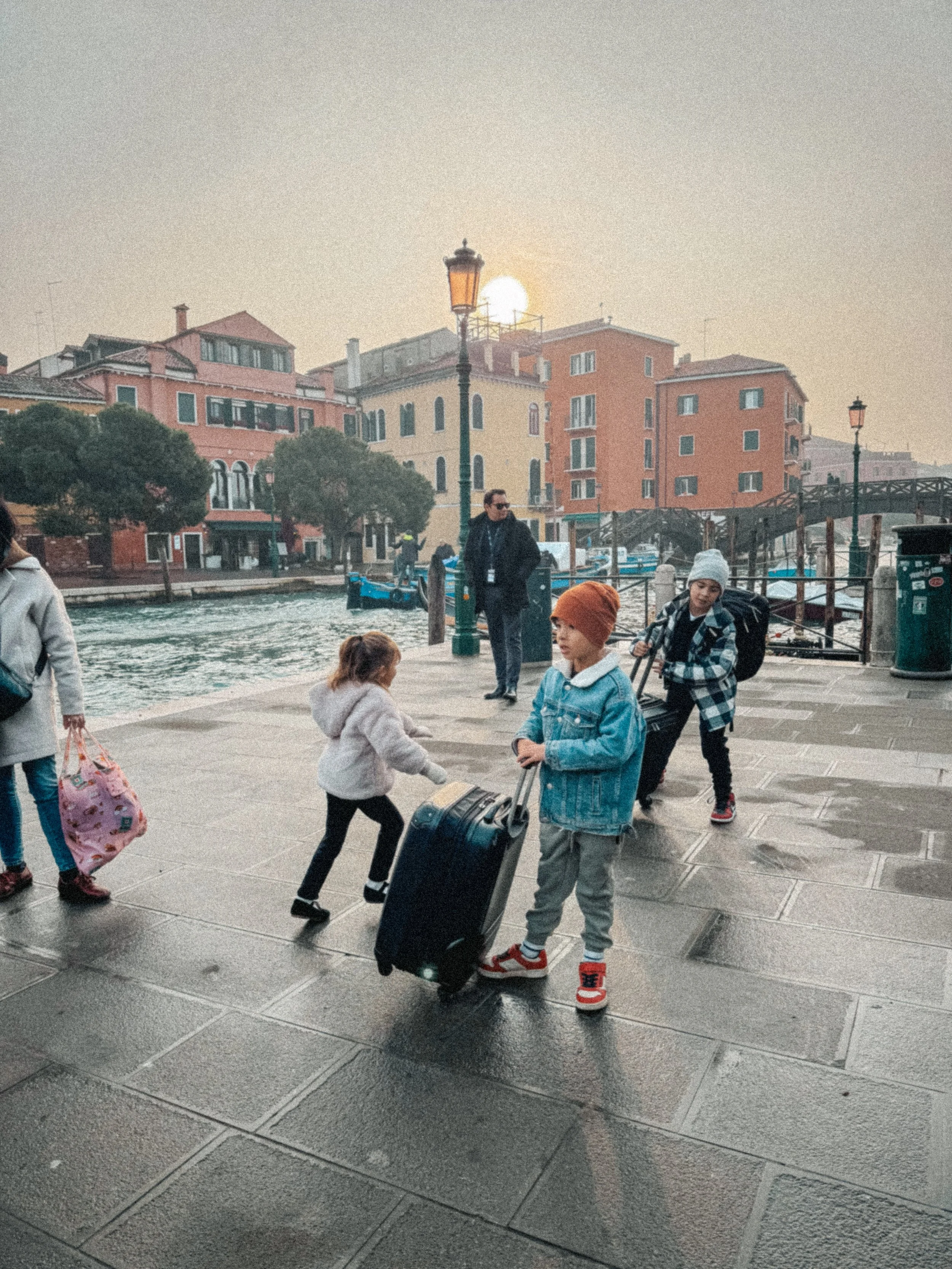
Arriving in Venice, Italy
Planning travel for a family is a lot like planning a wedding. Both require strategy to book, accommodate, feed, and exhilarate all guests to a standard no less than “perfect.” But even the most well-orchestrated trips can unravel (and weddings, too, for that matter). It’s how you tend to those moments — and turn mishaps into meaning — that shape how children remember travel, and how travel changes a family.
This realization came at the end of our two-week road trip across Italy.
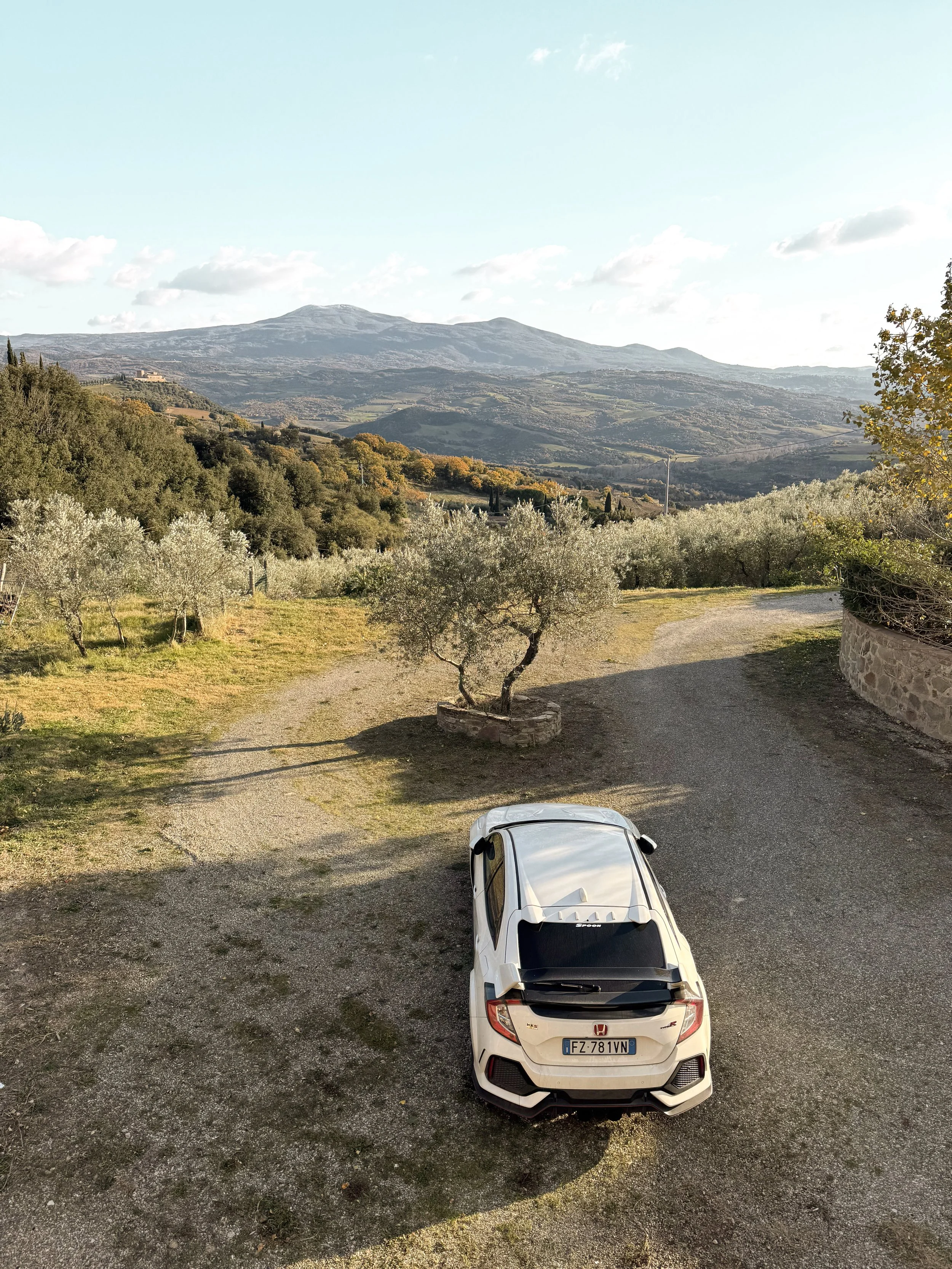
Outside Airbnb Il Borghetto, in Castelnuovo dell’Abate, Montalcino, Italy
We were following my composer father’s concert tour with an Italian flutist and quartet. We drove approximately 1,500 kilometres from Rome, across eastern Italy to Venice, and back down the Tuscan coast to Fiumicino. The itinerary was ambitious, but vivid.
From Montelabbate to Abano Terme, we travelled along pastoral highways lined with sunbleached farmhouses in wheat fields. We stayed at La Maggiolina, a modern villa with floor-to-ceiling windows that framed an unparalleled view of the Italian countryside. There, our oldest son Theo woke on his 9th birthday to orderly olive trees, running between them with his brother and sister.
Driving through Umbria towards Venice, we stopped for wood-fired pizza in a small town at the base of the Euganean Hills. Chimneys puffed smoke above quiet houses that folded into rolling green slopes, their window lights easily mistaken for stars at night. We still talk about how there was something soft about that volcanic landscape, something unexpectedly intimate.
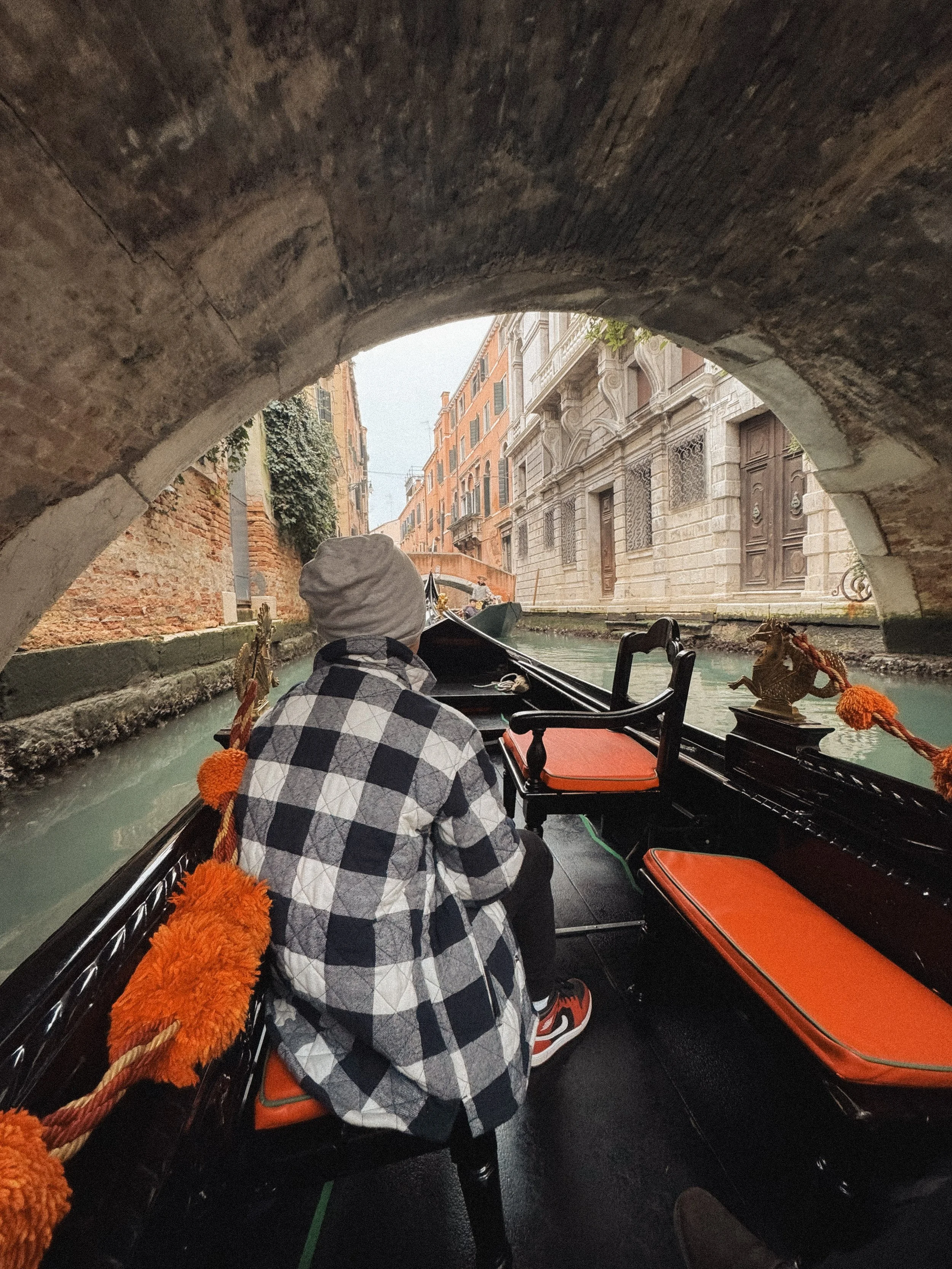
Riding the gondola in Venice, Italy
In Venice, my middle son, Charlie, begged for a toy fighter jet at a magazine stand in a busy, cobbled street. I’m usually bitter towards unintentional souvenirs, but hey, we’re on vacation, right? So we came away with six. That night, he lost his baby tooth in the gold bathroom of our palazzo hotel, where the Italian tooth fairy left him tre euro. We took gondola rides through colourful Venetian corridors and clinked glasses of Sangiovese with the musicians before plates of fresh lemon branzino and truffle pasta. Our itinerary was nothing short of sophisticated – even with three under-slept, jet-lagged kids in tow.
While all this translates beautifully onto a postcard, we hit trials before we even saw the inside of the aircraft. We had to reschedule our flight and rebook our accommodations because my daughter Naomi’s passport was about to expire. I cried at the airport when checking-in with the agent who broke the news. I remember Naomi rubbing my back on the way out.
In Montalcino, a historic watchtower town in Siena, our car nearly got stuck on an inexplicably steep path (unsure if it was a road after all) that left no more than three inches between tire tread and the cliffside. My maps couldn’t tell the difference between two escuela roads, so we ended up on the wrong one. I carefully got out of the car and made clumsy gestures directing my husband to reverse the Volvo SUV down the mountain. His head was out the driver’s window, studying the moving car against the bluff’s edge, both of us sweating from pit to toe from vertigo and fear that we put the kids at risk. As the sun began to set, there was no one in sight to help, not even a lamppost to guide the way. But God, that view was stunning. My husband didn’t think too much of it at the time.
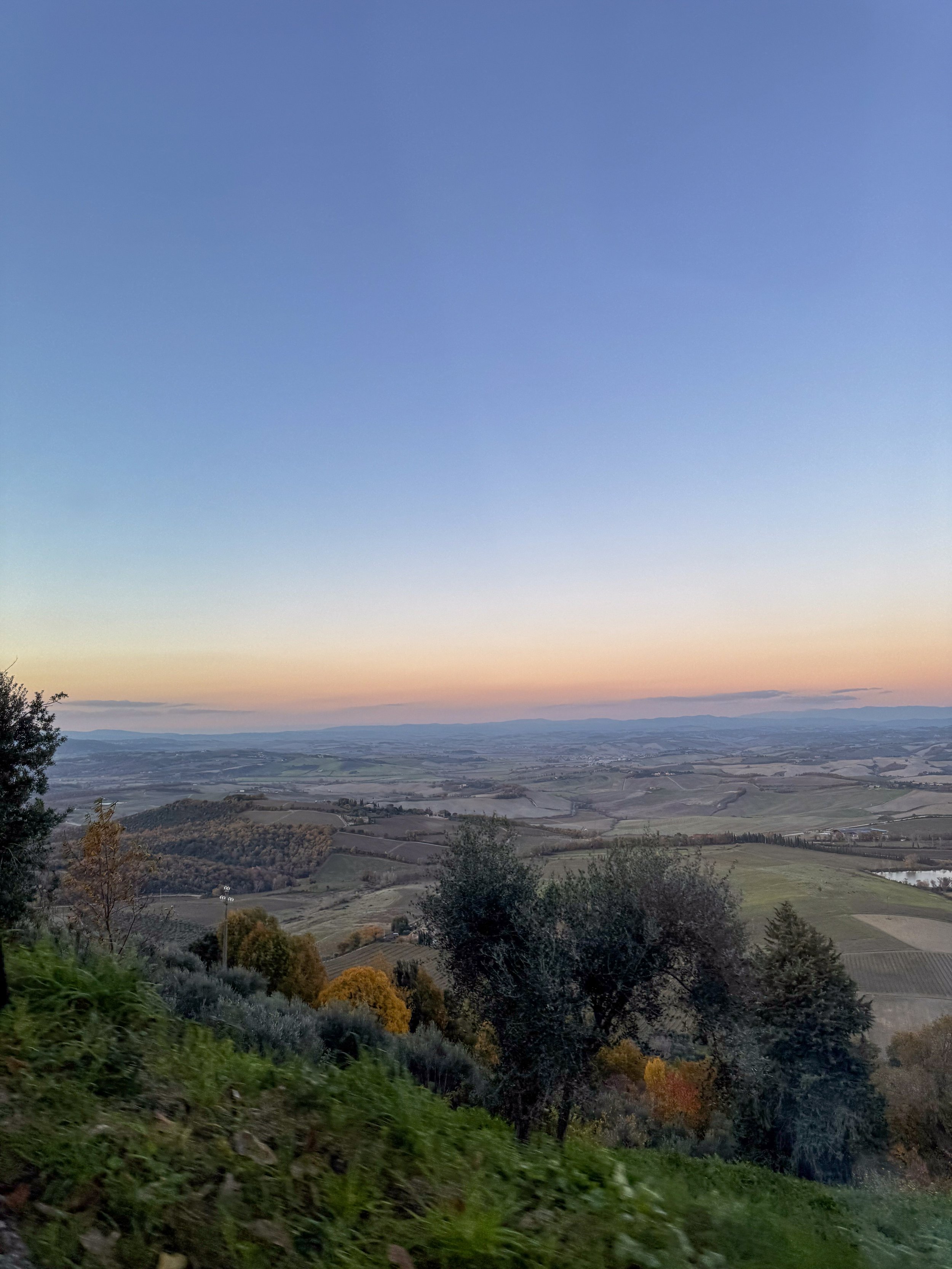
Montalcino, Siena
When we made it to Il Borghetto, a perfect (yes, perfect) bottle of Tuscan wine was waiting for us. Once we put the kids to bed, we immediately opened it and the sips cradled us inside out. Despite losing our bearings, we felt nothing more could overcome us. Besides, Il Borghetto was in a small medieval hamlet wrapped in vineyards, and we were treated to an unforgettable traditional meal by a family I still want to keep in touch with. A tousled eyebrow, compared to what happened next.
It was after a meal we were all hungry for in Florence that our trip back south went from fairly well-planned to worrisome. Charlie, who was newly proud of the gap in his smile, had fallen quiet. He could barely wake up from an impromptu nap on a patio. He had spiked a fever so high that a thermometer was unnecessary.
After four days, he wasn’t any better. By then, we timed Tylenol doses to keep to the plans, medicating him so he could join a long-anticipated private tour of the Colosseum with an Italian schoolteacher, and other demanding transitions around it. Not until picnic-side at the Rally del Brunello did my worry truly set in. Race cars were Charlie’s birthday theme that year and I wouldn’t dare ask what he’d trade to see the real thing. Yet, rally racers snarled their engines around Tuscany’s valleys just a stone’s throw away from where he was fast asleep.
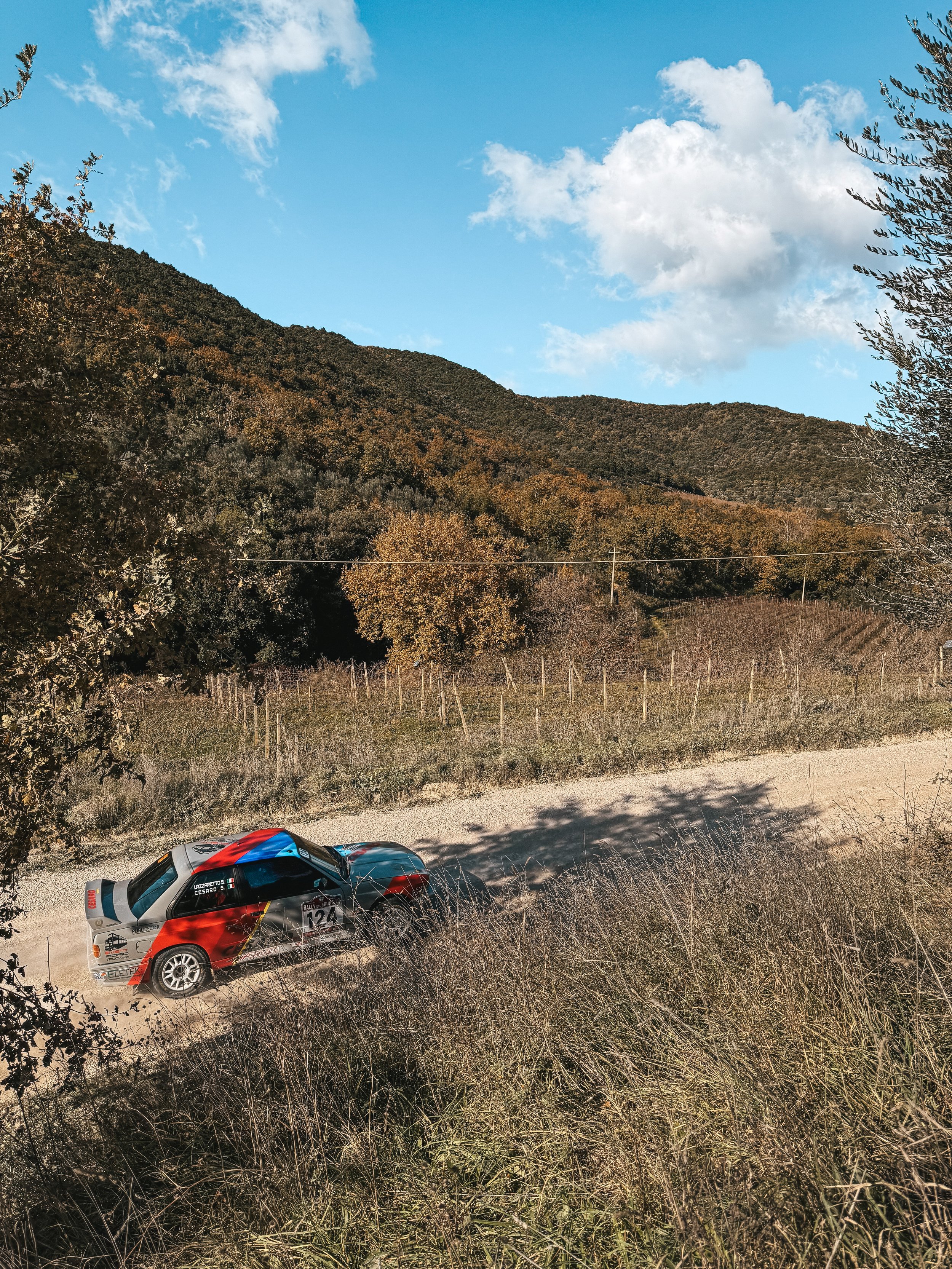
Race car at the Rally del Brunello 2024 in Montalcino
I was grieving a memory he had not formed, but already lost. Family holidays are high-pressure by design — bounded by time, burdened by cost, and buoyed by the unspoken expectation that everyone will be happy and healthy. Parents stretch themselves in every direction, trying to gather something lasting from a vacation made precious by its limits. So what if it doesn’t go your way?
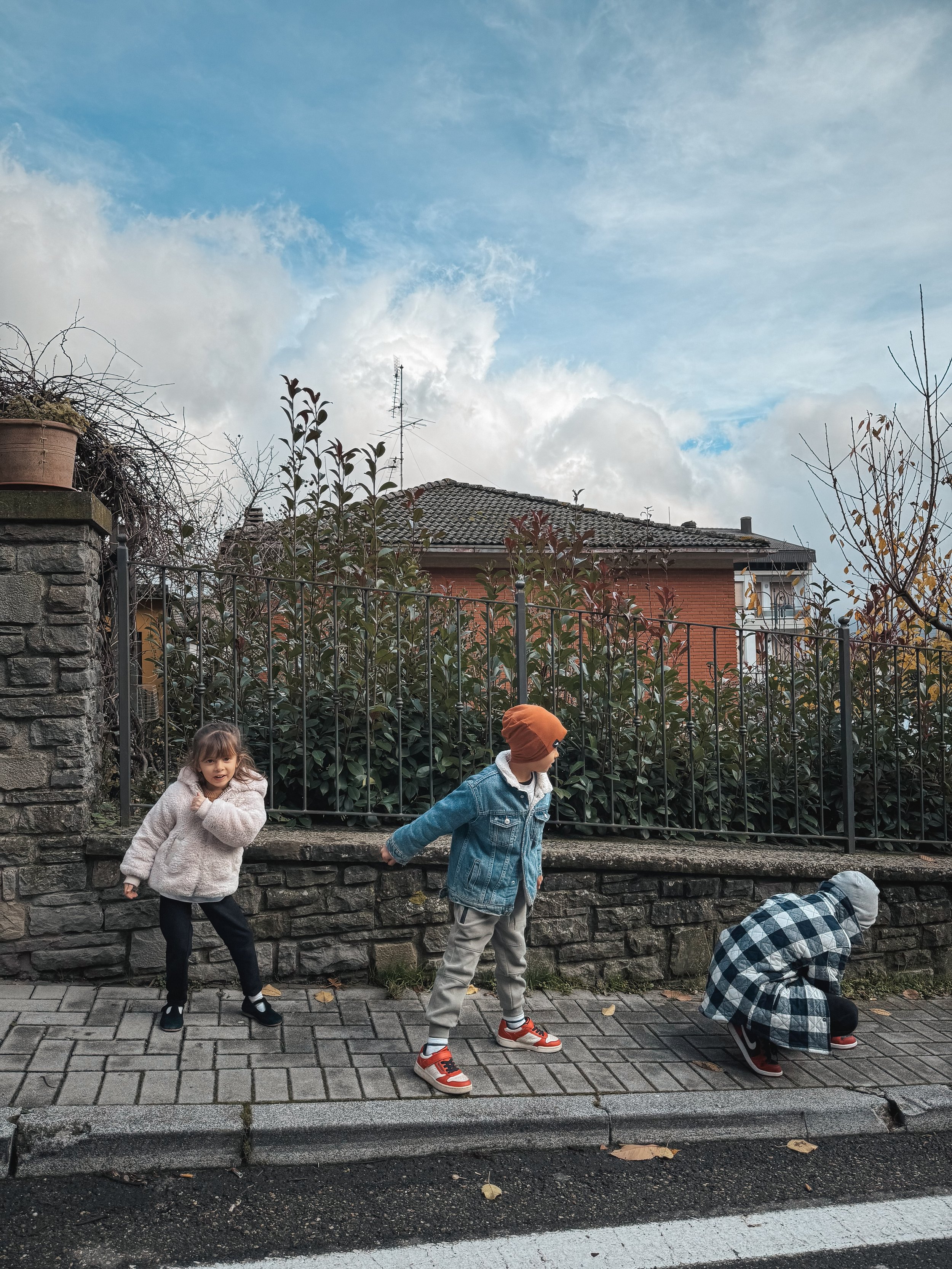
Kids playing in Abano Terme, Italy
Children remember travel less in the moments we try to collect than in how we respond when plans fall apart. When a day unravels — through illness, exhaustion, or disappointment — what is left is not the itinerary, but the atmosphere we create around it. In those moments, children are not learning where they are, but how to move through difficulty with the people they trust. And no one said fevers stay behind the border. So why aren’t we more accepting of the unscripted version?
I’ll never forget the moment a team of ambulance workers burst through our hotel door in the small beach town of Fiumicino, just outside Rome. Uniform and efficient — as if lifted from an Italian soap opera — the burlier paramedic scooped Charlie and carried him out. The front desk called them in the middle of the night after he broke out in viral hives. The timing felt cruelly precise: our final destination, our final night, nine hours before boarding. I still hoped we might make the flight home, but the doctor offered a blunt probabilmente no, without much softness to hold onto.
Then, a nurse appeared through the teal curtains of the hospital bay where Charlie and I waited — latex glove in hand. She spoke to him in Italian, words I couldn’t translate at 1 am. But she said them with a smile. She blew up the glove like a balloon, drew a face on it with a pen, and handed it to Charlie who instantly perked up (and so did I).
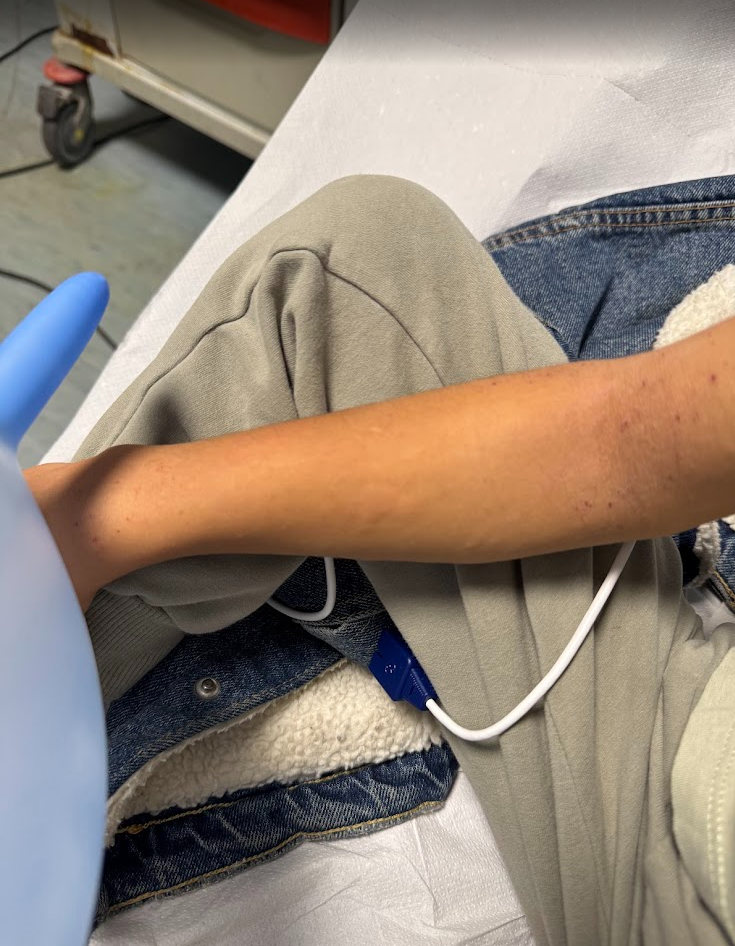
Charlie and I at Ospedale G. B. Grassi, Fiumicino, Italy
We spent the rest of the night giggling under fluorescent lights, taking turns animating a balloon-glove on a sheetless gurney in Fiumicino. Somewhere between laughter and exhaustion, colour returned to his cheeks. The hives faded. Not long after, we were discharged and flew home that morning. And you’ll never guess his most prized Italian souvenir – a deflated latex glove.
What changed my family’s approach to travel forever wasn’t the disruptions to the itinerary — it was the reminder that children don’t measure trips by what went according to plan. They measure them by how safe they felt when things didn’t. The kindness of a stranger, the steadiness of a parent, the fun that shows up when momentum disappears.
At least this is what my kids are still talking about.
Since then, I plan differently. I still dream big and map routes carefully, but I leave room — not just in the schedule, but in myself. Because the moments that linger aren’t always the ones we choreograph. Sometimes they arrive quietly, behind hospital curtains, reminding us that the most lasting souvenirs aren’t from places at all, but the way we learn to care for one another when everything else falls away. That is an itinerary I can vow, after a perfectly imperfect family trip to Italy.
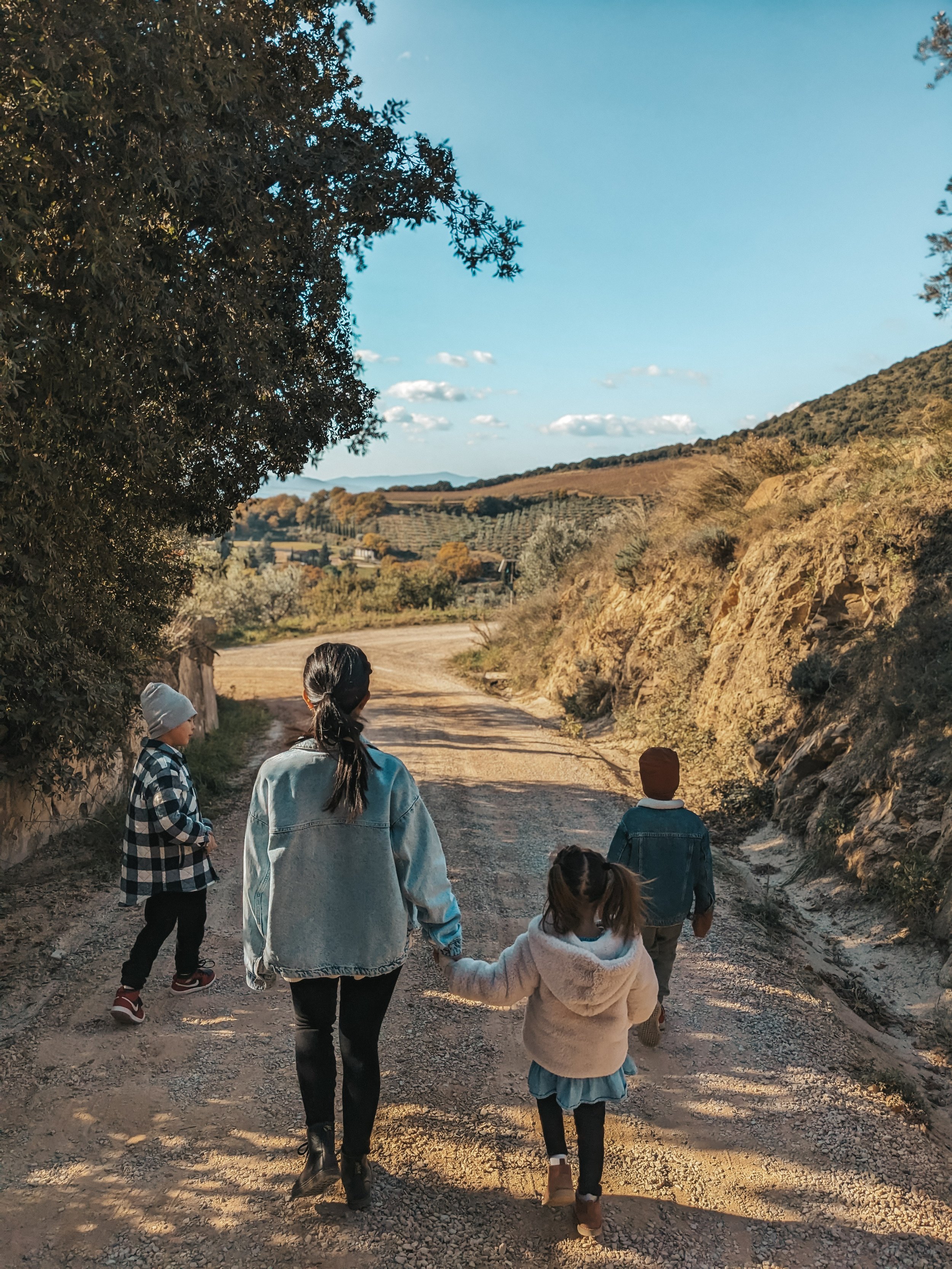
Countryside in Castelnuovo dell’Abate, Montalcino, Italy
